


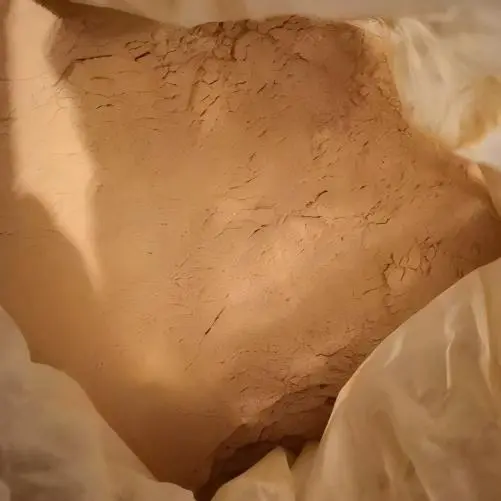
Cereal Extract CAS 85251-64-5 Cereal Extract
CAS No.:
85251-64-5
EINECS:
286-476-2
Packing:
25KG Drum
Shelf Life:
2 years
Color:
Brown
Appearance:
Powder
Place of Origin:
China
Brand:
Samreal
design customization
Please fill out the form below to request a quote or to request more information about us. Please be sure to upload customized requirement documents or pictures, and we will get back to you as soon as possible with a response. we're ready to start working on your new project, contact us now to get started.
Please fill out the form below to request a quote or to request more information about us. please be as detailed as possible in your message, and we will get back to you as soon as possible with a response. we're ready to start working on your new project, contact us now to get started.
Color
Brown
Shelf Life
2 years
Origin
China
Trademark
Samreal
Smell
Characteristic
Cereal Extract CAS 85251-64-5
Cereal extract, CAS 85251-64-5, fine powder
Product Source: Barley (a plant of the Poaceae family)
Product Details
| Appearance | Fine powder |
| Odor&Taste | Characteristic |
| Granular size | 80 mesh |
| Loss On Drying | ≤7.0% |
| Ash | ≤5.0% |
| As | ≤2.0ppm |
| Pb | ≤1.0ppm |
| Hg | ≤0.2ppm |
| Total Plate | <10000CFU/g |
| Mould | <50CFU |
| Coliform group | <10CFU |
| Salmonella | Negative |
Storage: Closed container. dry & cool. keep away from moisture &strong light
Shelf life: 24 Months
FAQ
The target market of our brand has been continuously developed over the years. For more information, please reach our team, we are more than happy to help.
1
Can I get samples?
Yes, some samples are available for free, while the courier cost is afforded by the buyers.
2
When can I get the quotation?
Our sales team will reply within 24 hours on working days.
3
What’s your MOQ?
For a courier delivery order,the MOQ is normally 100 g~1 kg; For an air transport order or sea delivery order ,the MOQ is usually 25 kgs.
4
What's your delivery time?
For a courier delivery order, delivery time is usually 5~7 working days. For an air transport order,usually around 7~10 working days. For an sea delivery order , usually around 10~20 working days.
5
How do you treat quality complaint?
First of all, our quality control will reduce the quality problem to near zero. If there is a real quality problem caused by us, we will send you free goods for replacement or refund your loss.
6
How to contact us?
You can send Mail:biz.chem@samreal.com; Or you can call us directly.
{{item.score}} Stars
{{item.pre}}%
{{item.nickname ? (item.nickname.slice(0, 2) + '*****') : item.source === 1 ? 'mall buyer' : '--'}}
{{item.comment_time}}
Review in the {{item.country}}
{{itemAttr.params_key}}: {{itemAttr.params_value}}
Get in touch with us
Just leave your email or phone number in the contact form so we can send you a free quote for our wide range of designs!
A comprehensive chemical Products company integrating technology development, production, sales and service
About Samreal Chemical
With a professional and experienced team, coupled with strong technical support from our partnerships with research institutes, we excel in developing innovative chemical products for our customers. If you are seeking to source new products, we are undoubtedly your ideal choice.
Shortcut links
Products
Contact with us
Tel: +86 - 21 - 68183739 /+86 - 574 - 87670845
Email: biz.chem@samreal.com
Ningbo Office: 18-7, Lane 645, No.312, Renmin Rd., Jiangbei District, Ningbo City, Zhejiang Province, China.
Shanghai Office: 522A, Building 47, No.1391, Weiqing West Road, Jinshan District, Shanghai City, China
Copyright © 2026 Samreal Chemical | Sitemap | Privacy Policy